
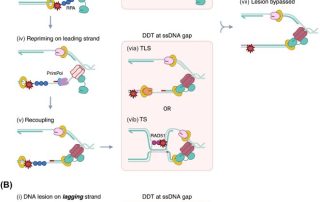
How cells replicate damaged DNA? Duxin lab revisited lesion bypass
It is not always safe to repair DNA Damage. Sometimes, cells "just bypass it". This review takes a fresh look at how cells replicate damaged DNA. During DNA replication, repair of lesions on DNA can be dangerous. Cells instead "tolerate" DNA damage and focus on finishing replication. This review, by Sidak Minocha, RepliFate members Marta Oliva-Santiago and Julien Duxin, and Sampath Amitash Gadi from the Biotech Research & Innovation Centre (BRIC) at the University of Copenhagen, revisited lesion bypass in light of recent advances. FULL ARTICLE [...]
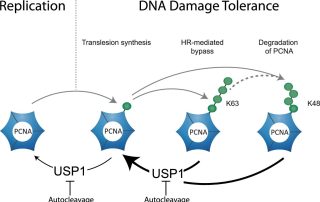
Titia Sixma’s lab showed how USP1/UAF1 targets polyubiquitinated PCNA with an exo-cleavage mechanism
Another recent publication highlight! The lab of Titia Sixma published a new study on how USP1/UAF1 can cleave ubiquitin chains on PCNA through an exo-cleavage mechanism. Key findings: USP1/UAF1 prefers to cleave K63- and K48 on polyubiquitinated PCNA using exo-cleavage. USP1/UAF1 prefers to cleave ubiquitin-ubiquitin bond over PCNA-ubiquitin bond. UAF1 plays a minor role in exo-cleavage preference for K63-PCNA-UbN. - USP1/UAF1 uses a bind, cleave and release mechanism when acting on PCNA-UbN. FULL ARTICLE
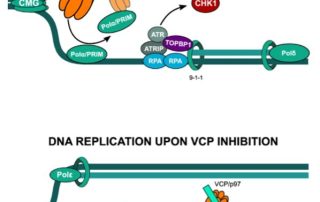
Collaboration between the labs of Lecona and Méndez uncovered a novel regulatory mechanism in DNA replication involving VPC/p97
The labs of Emilio Lecona Sagrado and Juan Méndez published a new study uncovering a novel regulatory mechanism in DNA replication involving VPC/p97. Their research reveals that VPC/p97-mediated extraction of DNA Pol α/primase from chromatin restricts overactivation of the ATR checkpoint pathway during unperturbed DNA replication. Key findings: VCP/p97 removes Pol α/primase from chromatin to suppress TOPBP1-dependent ATR activation under unperturbed replication conditions. Inhibition of VCP/p97 leads to the accumulation of Pol α/primase on chromatin, enhancing ATR signalling and triggering cell cycle arrest at G2/M. VCP/p97 acts as a safeguard against replication stress overreaction. [...]
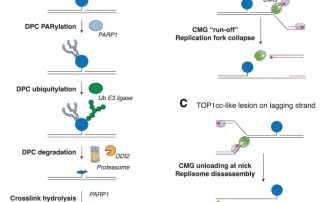
New Study Reveals PARP1’s Critical Role in Repairing DNA-Protein Crosslinks
Researchers from RepliFate have uncovered a novel DNA repair pathway orchestrated by the enzyme PARP1 that targets toxic DNA-protein crosslinks (DPCs). The study, published in Nature Communications, provides new insights into how cells handle these dangerous lesions and may explain the synergistic effects of certain cancer treatments. Key findings: PARP1 senses DPCs on single-stranded DNA gaps and those flanked by DNA nicks, like topoisomerase 1 cleavage complexes (TOP1ccs) PARP1 directly modifies the crosslinked proteins with poly(ADP-ribose) chains This PARylation triggers ubiquitination and subsequent degradation of the DPCs by the proteasome and other proteases Without [...]

Philippe Pasero (CNRS) elected to EMBO Membership
In RepliFate we are very happy and proud to congratule Philippe Pasero for his election as EMBO member. It is an honor to count with him as a member of the network. read the original article
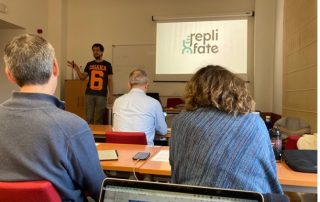
October 16-17 MSCA ITN Replifate Meeting in Baeza
The beautiful Baeza served as the backdrop for the MSCA ITN Replifate first annual meeting, a two-day event combining network introductions, research presentations, and PhD fellow training. Dr. Emilio Lecona's warm welcome marked the start, introducing the Replifate initiative. Six PhD fellows presented their projects on day one, with Prof. Karlene Cimprich delivering an insightful keynote on 'The Causes and Consequences of Replication Stress.' The second day featured another 6 fellows presenting their research, followed by FCAECC's valuable training on Patient engagement and funding opportunities. The meeting was a fruitful blend of science and [...]